

 English
 русский
 Deutsch
 Türk
 中文简体
Rubber Ring Selection Guide: Materials, Sizes, and Standards for Sealing Engineers
Rubber Ring Selection Guide: Materials, Sizes, and Standards for Sealing Engineers
Rubber Ring Selection Guide: Materials, Sizes, and Standards for Sealing Engineers
Rubber Ring Selection Guide: Materials, Sizes, and Standards for Sealing Engineers
Rubber Ring Selection Guide: Materials, Sizes, and Standards for Sealing Engineers
Rubber Ring Selection Guide: Materials, Sizes, and Standards for Sealing Engineers
Rubber Ring Selection Guide: Materials, Sizes, and Standards for Sealing Engineers
Rubber Ring Selection Guide: Materials, Sizes, and Standards for Sealing Engineers
Rubber Ring Selection Guide: Materials, Sizes, and Standards for Sealing Engineers
Rubber Ring Selection Guide: Materials, Sizes, and Standards for Sealing Engineers
Rubber Ring Selection Guide: Materials, Sizes, and Standards for Sealing Engineers
Rubber Ring Selection Guide: Materials, Sizes, and Standards for Sealing Engineers
Rubber Ring Selection Guide: Materials, Sizes, and Standards for Sealing Engineers
Rubber Ring Selection Guide: Materials, Sizes, and Standards for Sealing Engineers
Rubber Ring Selection Guide: Materials, Sizes, and Standards for Sealing Engineers
Rubber Ring Selection Guide: Materials, Sizes, and Standards for Sealing Engineers

Industry news
Home / News / Industry news / Rubber Ring Selection Guide: Materials, Sizes, and Standards for Sealing Engineers
NEW Category
Contact us
Rubber Ring Selection Guide: Materials, Sizes, and Standards for Sealing Engineers
Content
- 1 What Is an Industrial Rubber Ring and Why Its Specs Matter
- 2 Rubber Ring Materials: NBR, HNBR, FPM Compared
- 3 Shore Hardness and Cross-Section Size for a Correct Fit
- 4 Failure Modes in Gas Springs and Dampers
- 5 A Practical Specification Checklist for Procurement Engineers
- 6 Frequently Asked Questions About Rubber Rings
A gas spring in a recliner seat starts to leak at around cycle 8,000 in a production hall with 80 percent humidity. The usual suspect is the chrome rod, but the real failure sits in the rubber ring: it has lost its compression set, turned glossy on one side, and no longer presses against the cylinder wall. Selecting a rubber ring is not a size-matching exercise. It is an engineering decision controlled by material compound, shore hardness, cross-section geometry, and the installation groove. Writing those values down before ordering helps a procurement engineer avoid the most expensive type of failure in sealed assemblies: the silent leak that appears only after the product is already in the field.
What Is an Industrial Rubber Ring and Why Its Specs Matter
An industrial rubber ring is a precision elastomer seal that prevents gas or fluid leakage in static and dynamic applications, and its performance is decided by four measurable parameters: material compound, shore hardness, cross-section dimensions, and compression set.
Rubber ring definition: a circular elastomeric sealing element that fills the gap between two mating surfaces in a sealed assembly. Its sealing ability comes from elastic recovery, which keeps the compressed ring pressed against the metal or plastic counter-face.
The four parameters are interconnected. Material decides the temperature window and chemical resistance. Shore hardness decides extrusion resistance under pressure. Cross-section dimensions decide the fit in the groove. Compression set decides the time in service. If one of them is wrong, the other three cannot compensate.
In a gas spring, the rubber ring has just one job: to hold a 2 to 5 MPa gas charge inside the cylinder for the full rated cycle life. When an engineer specifies the wrong compound, the seal hardens, the gas escapes, and the spring loses its push force. The same logic applies to dampers, where the seal must separate oil from air without allowing foam to form.
NBR (Buna-N)
-30 to 120°C
Oil resistant, economical, standard for furniture gas springs.
HNBR
-30 to 150°C
H2S resistant, long service life, high-load gas springs.
FPM (FKM)
-15 to 200°C
Universal chemical resistance, high-temp rotary seals.
 Reinforced Rubber Sealing Gasket with 1.9mm Width for Pressure FluctuationsThis 13mm reinforced gasket increases contact surface area with a 1.9mm width, suited for industrial pipelines facing frequent pressure changes. Its higher radial preload helps seal uneven surfaces, making it a reliable choice in demanding conditions.View Product →
Rubber Ring Materials: NBR, HNBR, FPM Compared
Rubber ring material selection is the most important decision in gas spring and damper sealing, because the compound that works at 80°C will not survive at 150°C.
| Material | Temperature range | Oil resistance | Compression set at 100°C | Typical use |
| NBR (Buna-N) | -30 to 120°C | Excellent | 25-35% | Furniture gas springs, standard hydraulic O-rings |
| HNBR | -30 to 150°C | Excellent | 15-25% | High-load gas springs, dampers with compressor oil |
| FPM (FKM) | -15 to 200°C | Excellent | 20-30% | High-temp rotary seals, chemical plant valves |
An HNBR rubber ring is the default for gas springs that run above 100°C or in oil with H2S contamination. Its payback period is measured in avoided warranty claims, not in months.
The difference between NBR and HNBR shows up in a compression-set test. After 72 hours at 100°C, an NBR compound can retain only 70 percent of its original height, while an HNBR compound retains more than 80 percent. That gap is often enough to let the ring stop contacting the wall, which is the start of a leak. Ningguo Jnsseals Sealing Technology Co., Ltd. (JNS) manufactures rubber rings in NBR, HNBR, and FPM, and also produces reinforced Y-seals rated from 500N to 6000N for high-load gas springs. For a deeper comparison of compound properties, see this NBR, HNBR, FPM material comparison guide.
 HNBR High-Temp Corrosion-Resistant Y-Seal for Demanding EnvironmentsUpgraded to HNBR, this Y-seal offers excellent thermal stability and high resilience for complex chemical or high-temperature applications. It fits 101.5 O-rings and is designed for performance above 10N loads.View Product →
Shore Hardness and Cross-Section Size for a Correct Fit
Shore A hardness and cross-section size decide whether the rubber ring sits in the groove under correct compression or fails from extrusion.
Standard rubber rings are available in shore A 70, 80, and 90. As a rule: 70A suits a static seal, 80A fits a reciprocating seal up to 3 MPa, and 90A is required when the clearance gap exceeds 0.15 mm or when pressure peaks above 5 MPa.
Compression Set After 72h at 100°C (lower is better)
NBR 28%
HNBR 18%
FPM 23%
| Application | Shore A | Compression rate | Cross-section |
| Static gasket / flange | 70A | 15-20% | 2.62 or 3.53 mm |
| Dynamic reciprocating | 80A | 10-15% | 2.62 or 5.33 mm |
| High-pressure clearance | 90A | 10-15% | 3.53 or 5.33 mm |
Measure the groove cross-section with a tolerance of ±0.05 mm. The rubber ring cross-section should be 1.2 to 1.5 times the groove depth for a 10-15 percent compression rate. A groove that is too deep leaves the ring working like a loose washer and leaks without visible damage.
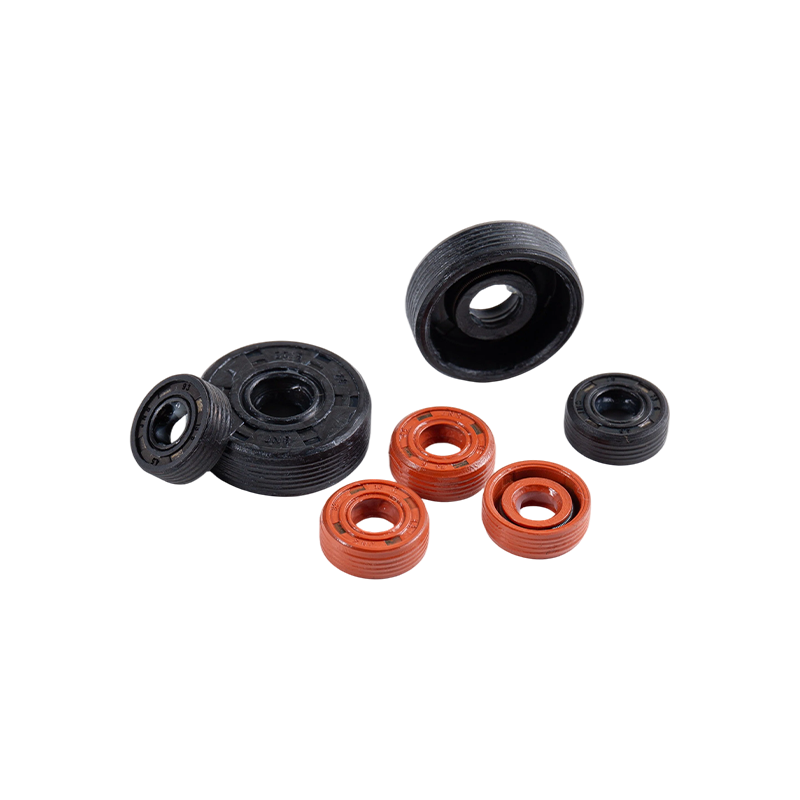 Industrial Balanced Damping Seal for 13mm OD Piston SystemsThe A-3-001 heavy-duty damping seal features a 4.5mm height for broader contact, ensuring smooth damping forces and preventing micro-leakage. Its NBR compound provides oil and wear resistance, optimized for 13*6 tube specs.View Product →
Failure Modes in Gas Springs and Dampers
The five most frequent rubber ring failure modes are compression set, extrusion, abrasion, spiral twist, and chemical attack. Each has a recognizable symptom.
- Permanent compression set: the ring flattens to less than 80 percent of its original cross-section, leaving a gap at the rod.
- Extrusion: rubber is pushed into the clearance gap, appearing as a thin flash on the downstream side.
- Abrasion: the contact face is rough, with fine black particles visible in the lift oil.
- Spiral twist: a helical diagonal cut in the ring, traceable to lubrication failure during assembly.
- Chemical attack: cracking, swelling, or softening after contact with a specific fluid.
Detecting these failures early is a matter of reading the seal condition. On a test bench, a worn rubber ring leaves a mirror-like band on the rod. An extruded ring shows a thin flash downstream of the groove. A spirally twisted ring has a diagonal scar that runs around the circumference. Once the pattern is identified, the fix is usually a change in shore hardness or cross-section, not a change in the whole seal design.
The fastest way to catch an extrusion problem before production is a simple rule: if working pressure exceeds 5 MPa and the clearance gap is greater than 0.15 mm, increase shore hardness by 5 points instead of buying a more expensive compound.
A Practical Specification Checklist for Procurement Engineers
Before you send a purchase order for a rubber ring, write down six values: fluid media, working temperature, working pressure, shore A hardness, cross-section, and material compound. This is the fastest way to cut trial orders and avoid first-run field failures.
- Define the media in contact: oil, gas, phosphate ester, or water-glycol.
- Record the continuous working temperature and the short-term peak.
- Choose the base polymer: NBR, HNBR, or FPM.
- Select shore A hardness from working pressure and clearance gap.
- Measure the groove diameter, groove depth, and groove width.
- Verify the compression rate and request the compression-set value on the material certificate.
If a rubber ring costs 0.15 USD but a leaking gas spring costs 6.50 USD in rework and warranty, the cheapest ring is rarely the most economical one.
Frequently Asked Questions About Rubber Rings
What is the difference between an O-ring and a rubber ring?
A rubber ring is the general name for any circular elastomeric seal. An O-ring is the most common form of rubber ring, but Y-rings and L-rings also fall in the same category. Y-rings are preferred for reciprocating piston seals because their lips generate radial load even at low pressure.
How do I know if a rubber ring is NBR or HNBR?
NBR and HNBR are hard to tell apart visually. The fastest practical check is a 72-hour immersion in hot oil at 100°C: HNBR retains more than 90 percent of its original hardness, while NBR typically falls to about 85 percent. A more precise route is a compression-set test after the same duration.
What shore A hardness should a rubber ring have for a gas spring?
For a gas spring piston and rod seal, start with shore A 80. If pressure peaks above 3 MPa, move to 90A. For low-pressure static seals, 70A is enough.
How should a rubber ring be stored before installation?
Store it in a dry, dark room below 25°C, away from ozone sources such as electric motors, and keep the original sealed packaging. Storage beyond 24 months without inspection can degrade the surface state before the ring is mounted.
PREV:High-Pressure Reinforced L-Type Seal: Engineering Guide for Gas Spring Dampers
NEXT:L-Shaped Oil Seal Ring: Engineering Guide for Piston, Rod, and Gas Spring Seals
NEXT:L-Shaped Oil Seal Ring: Engineering Guide for Piston, Rod, and Gas Spring Seals


Want to know more
about us?
about us?

Precision sealing for gas springs and dampers. Durable, wear-resistant, and built for long-life performance in demanding applications.
Product Categories
Quick Links
Contact Us
-
Email: jns@jnsseals.cn

-
Manager Gong: +86-18563770820

-
Manager Wang: +8615357558902
-
No. 5, Meilin Avenue, Meilin Industrial Development Zone, Ningguo City, Anhui Province, China

