

 English
 русский
 Deutsch
 Türk
 中文简体
Industrial Standard L-Ring Kinetic Seal: Specs, Tolerances, and Failure Fixes
Industrial Standard L-Ring Kinetic Seal: Specs, Tolerances, and Failure Fixes
Industrial Standard L-Ring Kinetic Seal: Specs, Tolerances, and Failure Fixes
Industrial Standard L-Ring Kinetic Seal: Specs, Tolerances, and Failure Fixes
Industrial Standard L-Ring Kinetic Seal: Specs, Tolerances, and Failure Fixes
Industrial Standard L-Ring Kinetic Seal: Specs, Tolerances, and Failure Fixes
Industrial Standard L-Ring Kinetic Seal: Specs, Tolerances, and Failure Fixes
Industrial Standard L-Ring Kinetic Seal: Specs, Tolerances, and Failure Fixes
Industrial Standard L-Ring Kinetic Seal: Specs, Tolerances, and Failure Fixes
Industrial Standard L-Ring Kinetic Seal: Specs, Tolerances, and Failure Fixes
Industrial Standard L-Ring Kinetic Seal: Specs, Tolerances, and Failure Fixes
Industrial Standard L-Ring Kinetic Seal: Specs, Tolerances, and Failure Fixes
Industrial Standard L-Ring Kinetic Seal: Specs, Tolerances, and Failure Fixes
Industrial Standard L-Ring Kinetic Seal: Specs, Tolerances, and Failure Fixes
Industrial Standard L-Ring Kinetic Seal: Specs, Tolerances, and Failure Fixes
Industrial Standard L-Ring Kinetic Seal: Specs, Tolerances, and Failure Fixes

Industry news
Home / News / Industry news / Industrial Standard L-Ring Kinetic Seal: Specs, Tolerances, and Failure Fixes
NEW Category
Contact us
Industrial Standard L-Ring Kinetic Seal: Specs, Tolerances, and Failure Fixes
Content
- 1 What an Industrial Standard L-Ring Kinetic Seal Actually Does
- 2 Groove Tolerances and Surface Finish That Decide Seal Life
- 3 Choosing the Right Material for an Industrial Standard L-Ring Kinetic Seal
- 4 Why Industrial Standard L-Ring Kinetic Seals Fail in Gas Spring and Damper Service
- 5 A Practical Specification and Verification Checklist
- 6 Frequently Asked Questions
A gas spring that loses preload after 80,000 cycles is usually sent back as a spring problem. In most teardowns the rod is still straight, the nitrogen charge is still within tolerance, and the failure sits in a six-millimeter groove: the industrial standard L-ring kinetic seal has hardened, worn a flat onto its lip, or extruded into the gap.
Kinetic L-ring seals are the small, asymmetrical lip seals that sit in the rod or piston groove of gas springs, dampers, and light hydraulic actuators. They cost a fraction of the assembly around them, which is exactly why they get specified last, matched to whatever groove was already drawn, and validated on a short bench test at room temperature.
This guide covers what an industrial standard L-ring kinetic seal actually has to do, which numbers control its service life, how material choice shifts the temperature ceiling, and how to specify and verify one so it survives real damper duty.
What an Industrial Standard L-Ring Kinetic Seal Actually Does
An industrial standard L-ring kinetic seal is a single-acting lip seal with an L-shaped rubber cross-section that seals a moving rod or piston by letting system pressure energize its lip against the counterface.
That shape decision is the whole point. A plain O-ring relies on squeeze alone, so it seals acceptably up to a few bar and then starts to roll under pressure. The L-ring adds a pressure-energized leg: the harder the pressure pushes, the tighter the lip presses onto the shaft.
The industrial standard L-ring kinetic seal combines two functions in one molded part: a static seal at the groove heel, where the short leg of the L sits compressed in the housing, and a dynamic seal at the lip, where a thin, flexible leg rides on the moving surface and is loaded by system pressure rather than by squeeze alone.
Three duties have to be satisfied at the same time, and a seal that is strong in one is usually weak in another:
- Static sealing at the heel. The short leg is compressed between the groove floor and the side wall, blocking leakage past the outside diameter.
- Dynamic sealing at the lip. The long leg contacts the rod with light preload, then flexes further as line pressure rises.
- Extrusion resistance at the gap. The heel backs up the lip so the rubber has somewhere to go other than the clearance between rod and housing.
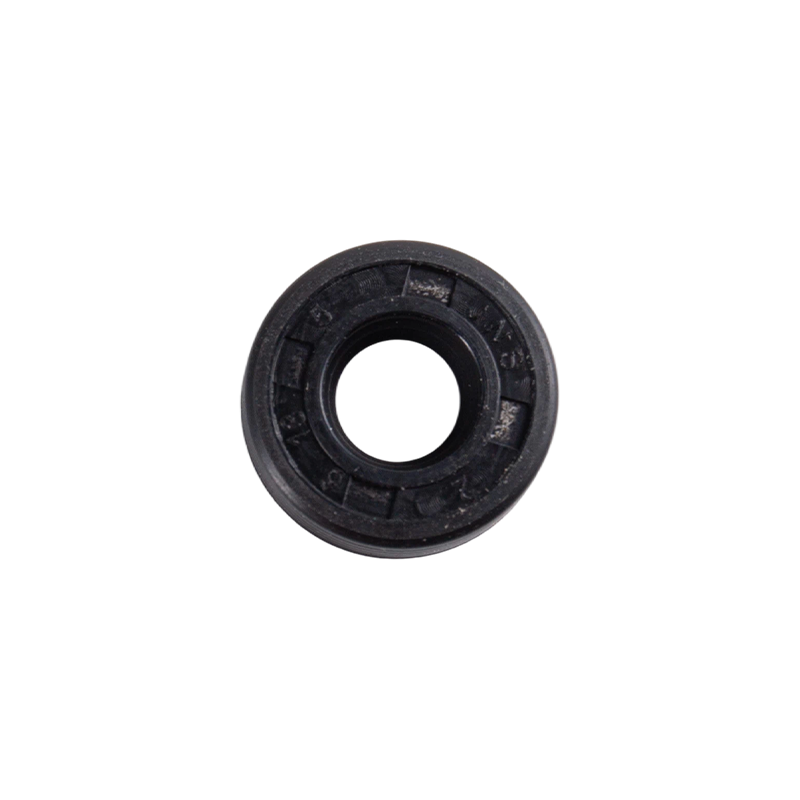 Industrial Standard L-Ring Kinetic Seal A-2-002L-shaped NBR kinetic seal for 16x8 rod assemblies, 60–700 N; suited to industrial automation where groove precision and lip stability are decisive.View Product →
Because the same geometry has to do all three jobs, the L-ring is far less forgiving of housing error than an O-ring. A groove that is 0.1 mm off nominal can turn a 500,000-cycle seal into an 80,000-cycle seal without any change in the rubber compound.
Groove Tolerances and Surface Finish That Decide Seal Life
Four numbers decide how long an industrial standard L-ring kinetic seal lasts: dynamic surface finish, extrusion gap width, groove width tolerance, and counterface hardness.
Seal compounds rarely fail from age in gas spring service. They fail because the metal around them creates a leak path. A groove cut slightly too wide lets the L-ring rock under alternating pressure, and a rod finished at Ra 0.8 micron acts like a file on the lip with every stroke. Surface finish is the cheapest variable to control and the one most often left to a general machining note.
| Parameter | Typical target | What happens when it drifts |
| Dynamic surface finish, Ra | 0.1 - 0.4 micron | Coarse finish shears the lubricant film; lip wear accelerates and low-pressure weeping appears |
| Radial extrusion gap | 0.15 - 0.25 mm at 10 - 16 MPa | Wider gaps let the lip cold-flow and nibble; tighter gaps raise friction, heat and stick-slip |
| Groove width | +0.05 / 0 mm against nominal | Too wide and the seal rocks and rolls; too narrow and the lip is pre-loaded before pressure arrives |
| Groove floor finish, Ra | 0.8 micron or finer | Rough floors cut the static sealing face and open a path under pressure |
| Counterface hardness | 45 - 60 HRC, chrome or nitrided | Soft shafts pick up dents and scratches that tear the lip within a few thousand cycles |
| Lead-in chamfer | 15 - 20 degrees, R 0.2 - 0.4 mm | Sharp entry edges shave rubber during assembly and cause day-one leaks |
0.15 - 0.25 mm Extrusion gap at 16 MPa
Ra 0.1 - 0.4 Micron dynamic finish
70 - 90 Shore A Typical L-ring hardness
If you are rebuilding an existing housing rather than designing a new one, measure the groove before choosing a seal. For a step-by-step tolerance walkthrough covering piston rod and cylinder geometry, see this L-ring seal engineering guide for piston rod applications.
Choosing the Right Material for an Industrial Standard L-Ring Kinetic Seal
Material selection sets the temperature ceiling and the chemical envelope of an industrial standard L-ring kinetic seal; groove geometry only sets how well that material performs once it is installed.
The chart below shows continuous service limits for the four compounds that cover almost all gas spring and damper work. Treat the upper number as a hard ceiling, not a target, and derate by 20 C whenever the seal sees continuous load.
Continuous service temperature range by L-ring compound
FKM -20 to +200 C
HNBR -40 to +150 C
NBR -30 to +100 C
PU -30 to +90 C
Bar length is proportional to the usable span between the low and high continuous limits. Short excursions above the upper limit are survivable; sustained operation there is not.
- NBR (nitrile butadiene rubber). The default for compressed air and mineral oil dampers. Excellent value, but compression set climbs quickly above 80 C and it hardens under ozone exposure.
- HNBR (hydrogenated nitrile). The practical upgrade for hot damper service. It keeps tensile strength and sealing force at 120 - 150 C and resists ozone and sour gas far better than NBR.
- FKM (fluorocarbon, also written FPM). The high-temperature and aggressive-media option. Higher cost and weaker low-temperature flexibility, so it is a poor choice for cold-start applications below -20 C.
- PU (polyurethane). Best abrasion resistance of the group, which suits dirty rod environments, but it hydrolyzes in hot water and steam and should not be used above about 90 C.
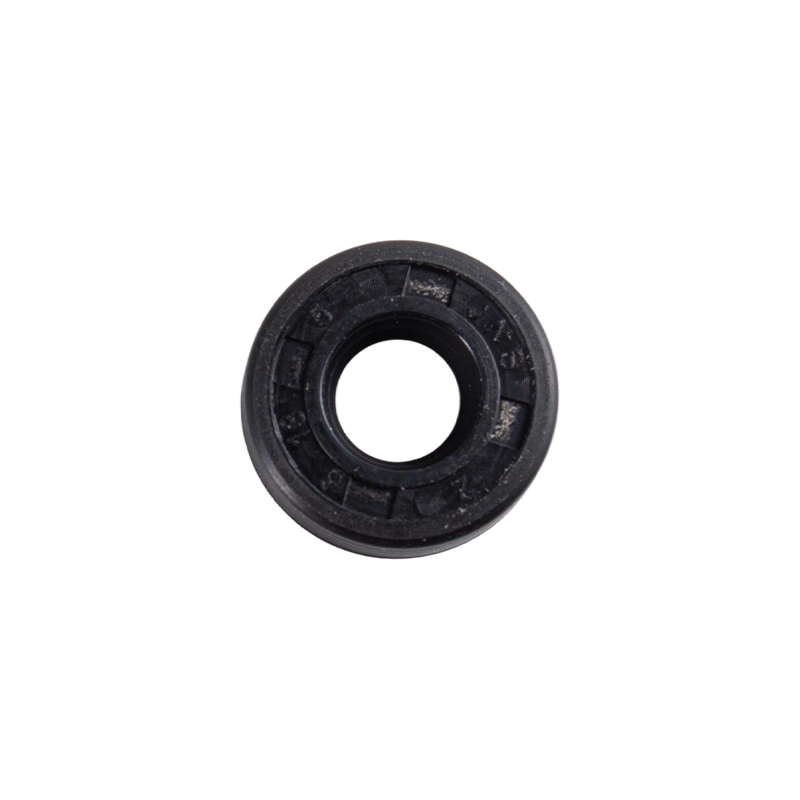
 Medium-Duty Balanced L-Type Oil Seal A-2-003L-shaped NBR seal for ISO 20x10 grooves and 50–1300 N hydraulic reversals; useful where stable radial pre-load and oil compatibility matter.View Product →
Why Industrial Standard L-Ring Kinetic Seals Fail in Gas Spring and Damper Service
Most field failures of an industrial standard L-ring kinetic seal are mechanical rather than chemical: extrusion, lip hardening, installation damage, and lubricant starvation account for the large majority of leaks.
Each failure mode leaves a different signature on the lip, and reading that signature is the fastest way to fix the root cause instead of replacing the seal a third time.
- Extrusion into the gap. At 16 MPa and 60 C, a 70 Shore A NBR lip will cold-flow into any clearance wider than about 0.2 mm. The signature is a flattened, feathered lip edge on the pressure side, with a sharp step where the rubber was sheared off.
- Lip hardening and compression set. Damper duty cycles run hot. Nitrile held near 100 C loses a significant share of its sealing force over a few thousand hours, and the lip stops following the rod. The signature is a glossy, cracked lip and a leak that appears only after the unit is warm.
- Installation damage. A sharp groove edge, a burred port, or a dry push-through can shave a sliver off the lip. The signature is a clean diagonal cut and a leak inside the first few hundred cycles.
- Lubricant starvation. Gas springs are often assembled with minimal oil. Without a film, the lip runs against bare metal, and a rough finish turns the pair into an abrasive wear couple. The signature is uniform polishing along the whole contact band.
A recurring pattern in light damper assemblies: the seal is approved on a 20 C bench test at 1 Hz, then shipped into a unit that idles at 85 C with a 0.28 mm extrusion gap. Both numbers are outside the L-ring window, and the failure appears as a warm leak at roughly 60,000 to 90,000 cycles. Tightening the gap and moving from NBR to HNBR usually resolves it without changing the housing drawing.
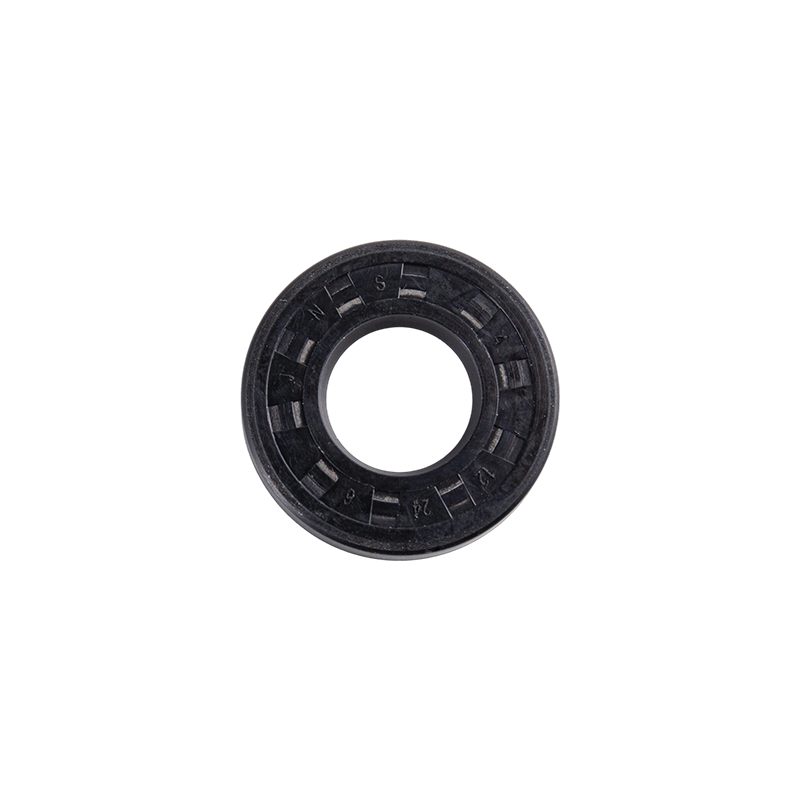 High-Pressure Reinforced L-Type Seal A-2-004Heavy-duty NBR L-series seal for 24x10 rod assemblies and 600–1800 N; anti-extrusion profile and thickened lips suit high-thrust lifting or pressing.View Product →
A Practical Specification and Verification Checklist
Start with the duty cycle, not the groove. Working in this order prevents the most expensive mistake in kinetic seal specification: choosing a seal that fits the housing but not the application.
Specify this
- State the real duty cycle: pressure range, stroke, cycles per minute, and the temperature at the seal, not the ambient temperature
- Pick the compound from the maximum continuous seal temperature and keep a 20 C margin
- Size the groove to a published housing standard so a second source stays possible
- Call out counterface finish at Ra 0.1 - 0.4 micron and hardness at 45 - 60 HRC on the drawing
- Chamfer every entry edge and wet the seal with the system lubricant during assembly
Avoid this
- Selecting the seal purely from groove dimensions taken off an old part
- Putting a 100 C nitrile compound into a damper that idles at 85 - 90 C
- Relying on a thin decorative chrome layer for abrasion resistance
- Approving a design from a 20 C bench test and shipping it into a hot application
- Accepting a supplier without a hot-cycle endurance report and a dimensional report
Verification is where most projects lose time. Ask for three things before a production release: a dimensional report on groove width and radial height, a compression-set figure at the expected seal temperature, and a hot endurance run at the real duty cycle. Suppliers that combine manufacturing with design, testing, and technical consulting, such as Ningguo Jnsseals Sealing Technology Co., Ltd. (JNS), can usually run that validation alongside the sample rather than after it.
Frequently Asked Questions
What is the difference between an L-ring kinetic seal and an O-ring?
An L-ring is pressure-energized, meaning system pressure actively pushes the lip against the shaft, so it holds at far higher pressures than a squeeze-only O-ring of the same hardness. An O-ring is simpler, cheaper and better suited to static sealing or low-pressure dynamic duty.
Can an industrial standard L-ring kinetic seal be used on both rods and pistons?
Yes, but the orientation must match the application. A rod seal energizes from the inside diameter outward, while a piston seal energizes from the outside diameter inward. Fitting a rod version into a piston groove reverses the pressure direction and destroys the lip in a short time.
What counterface finish should I specify for a kinetic L-ring seal?
Specify Ra 0.1 - 0.4 micron on the dynamic surface, with hardness between 45 and 60 HRC. Finishes coarser than Ra 0.8 micron shear the lubricant film and shorten seal life, while extremely fine finishes below Ra 0.05 micron can starve the lip of the micro-pockets that carry oil.
How do I tell whether a failed seal extruded or simply wore out?
Look at the pressure-side edge. Extrusion produces a feathered, flattened lip with a sharp shear step and material pushed into the gap. Normal wear produces a smooth, uniform contact band with no step. Extrusion points to gap clearance and pressure; wear points to surface finish, temperature, and lubrication.
PREV:No previous article
NEXT:Industrial Balanced Damping Seal: Specs, Materials, and Selection Guide
NEXT:Industrial Balanced Damping Seal: Specs, Materials, and Selection Guide



Want to know more
about us?
about us?

Precision sealing for gas springs and dampers. Durable, wear-resistant, and built for long-life performance in demanding applications.
Product Categories
Quick Links
Contact Us
-
Email: jns@jnsseals.cn

-
Manager Gong: +86-18563770820

-
Manager Wang: +8615357558902
-
No. 5, Meilin Avenue, Meilin Industrial Development Zone, Ningguo City, Anhui Province, China

